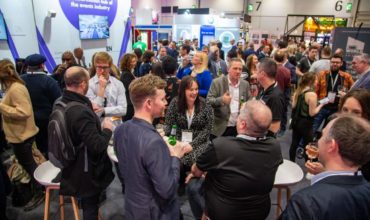
Doug Chorpenning, from the Wet Paint Group, explains what makes an event stick
The Wet Paint Creative Group is a company that prides itself on an innovative approach to business events, branding, corporate messaging and experiential marketing.
Founder and CEO Doug Chorpenning claims to approach event design like Picasso, Warhol and Dr Seuss approached a canvas. Each one a one-of-a-kind experience; where every brushstroke is an opportunity meaning and inspiration.
In place of attendees are participants, where an event’s success is predicated on full involvement not passive awareness. To promote this, the design of the event is tailored to cultivate the ideal platform to showcase motivational messages and goals, be they for an incentive, sales meeting or other customer appreciation event. And while orchestrating logistics, managing budgets, producing corporate entertainment and fine-tuning the branding is important, making events remarkable and memorable stems from a deeper understanding of connectivity and creativity, Chorpenning claims.
“We know events are a focal point around which productive client relationships, brand loyalty, company culture, and incremental revenue are built,” he says. “And the more extraordinary the event, the more extraordinary the returns.”
We, as event professionals, have a profound responsibility to support the marketing efforts and initiatives within our organisations and help organisations ‘live their brand out loud’, according to Chorpenning.
However, in our industry we are often treated like the “stepchild in the marketing mix”. While we think about the power of events due to living them all the time, we can still elevate our industry to the level it should be, comparable to advertising, public relations, direct mail and digital.
Events are critical
Chorpenning’s approach to event creation spans several of these mediums and has seen him work with organisations including Time Warner, Apple, Western Union, McAfee, Hitachi and the Dish Network, to name just a few.
“Events are a critical part of telling your story; and you must make your moments matter within an event,” he says. “I spend a great deal of time with my clients to figure out the ‘why’ behind their event. We’re not party planners, we’re the custodians of the brand.”
The formula Wet Paint Creative Group uses, the construct of its event design, is threefold. How do you create intrigue, how do you inspire people, and how do you immerse them in the experience so that those stories will spread.
“If you look at intrigue, its purpose is to rouse curiosity as well as to fascinate,” says Chorpenning. “So when you’re in the process of looking at your event, you’re trying to get away from simple logistics. Because logistics to me are a simple commodity. Anybody can do logistics; anybody can do an event.” And while Chorpenning is careful not to discredit the “tireless” hard work logistics providers do, it is the intrigue that ensures people are already excited prior to the event actually taking place.
“How do you fascinate them? Because our attention spans now are shorter
than ever,” he asks. “Think about what your event is and what the backdrop should be. The setting of your event does that. It captures the imagination and builds the experience. How do you find unique, inventive, innovating ways to tell your story.”
For example, complementary technology is wasted if you don’t get the plotline right. Chorpenning likens it to a movie or a book. “You need to have the right actors. You need the right plot, the right editing – and as with a great movie, you can tell the difference if all those things don’t line up.”
Specification is also often misjudged. “I was in Las Vegas, talking to people in the hotel industry, and they said they get frustrated when they receive an RFP for a conference or convention, a trade show and incentive trip or any meeting, where the RFP goes everywhere from the Hard Rock to the Bellagio.
“To me that’s a waste of everyone’s time and I think we owe it to our clients and our stakeholders to understand what it is we’re trying to communicate. If the Hard Rock works, then look at properties like that. If it’s a Bellagio audience, then look at other hotels like Caesars or Four Seasons.
Chorpenning maintains he gives his clients just three options for their event. “If you know your client well, then you don’t need 20 options. I don’t give my kids 20 options of what to eat for dinner. Narrow it down and it makes it a whole lot easier on everybody,” he says.
Money is one way to drive people and motivate them, but Chorpenning believes what people want more is to have some sort of impact on the world. Then through your event theme, communications and activities, think about how to really inspire people to be the best they can be through your event.
You find the right people and then you engage them
“Again, it comes down to how do you activate your participants. Attendee is a passive word, like people turning up to a party. You want active and inspired participants,” he adds.
Chorpenning says organisers need to get participants to ask themselves what is truly possible, and not in a Tony Robbins-type way. Do it correctly and they may leave thinking about something that could have a profound impact on who they are and how they interact with other people.
“We as organisers all want to be irreplaceable and by doing these different activities and being open to different ways of thinking, we can be,” he says. “Some people think ‘I’m not creative’ or ‘I don’t know how to draw – I can’t draw a stick figure’. But you can of course go and find the right people. Go and talk to them. You find the right people and then you engage them, and you’ll create magnificence like that.”
But while Chorpenning is conscious there is the risk his observations resemble platitudes and generalities, they do stand true and there is a need to bring these words and concepts to life through events. “You take the brand, whatever it is, and take your, and your client’s, objective to create a compelling message. It has to be authentic, it has to be real and it has to be meaningful,” he says.
“You have to be careful about your word choices. For instance, if I say ‘today you’re going to learn about X,Y and Z’, versus ‘today you’re going to discover the answers to X,Y and Z.’ The language you use can change the event.”
Again that goes to the design of the event, he says. You lead your people to believe that anything is possible, and people will respond in a far more satisfying way.
“Get away from the world of logistics, because sending out documents and booking hotel rooms does not on its own provide the level of value that we need to provide.
“It’s all about telling your story, selecting the right venue, being intentional, creating unique touch-points and leaving your participants with the feeling that it’s an authentic community.
“Live your brand out loud,” he says.