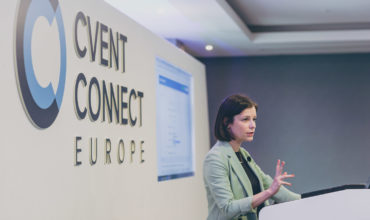
 Graham Pope (pictured left), vice-president of international sales at Cvent, tells Martin Fullard the staffing problems faced by venues could be offset with instant-book technology, as a new report indicates a swell of in-person events is coming
The impact of staffing shortages across the industry is very much a global concern, and it is creating problems on multiple fronts. One such area to feel the pinch is the speed at which a venue can turnaround an RFP. Is there, then, a technological answer which can ease the burden on both organiser and venue? Graham Pope, vice-president of international sales at Cvent, thinks there is. I met him at Cvent CONNECT Europe, London.
Martin Fullard: Outline the impact of staff shortages as you see them.
Graham Pope: Staffing shortages impact both the planning side and the hospitality side of the events industry. I think the pandemic brought about a big exodus of people from those industries globally, because, frankly, they were quite unstable and uncertain. Brexit, too, has had an impact in the UK, especially in hospitality.
We’re in a situation where many hotels don’t only lack staff, but they are struggling to recruit. Salary expectations have gone up significantly, and getting people on board, even cleaning staff, is proving challenging.
If you look specifically at the meetings and events perspective, as businesses recover post-pandemic, there’s been a huge upswing in demand for face-to-face meetings. RFPs are flying through from planners to venues and hotels and data reveals it is growing month to month.
However, the problem is the hotels haven’t got staff there to facilitate responses to many of these RFPs. The response times have become slower, or non-existent in some cases, which is frustrating for organisers who, of course, have fewer staff, too, and need faster responses.
This is a global concern.
MF: What tips then do you have for venues to work around this?
GP: It is a complex world in the hospitality space. Last year, the president of one of the major chains said: “Digitisation is the opportunity for hoteliers to really capture a disproportionate market share moving forward”. The challenge for a lot of these hotels, and the reason they’re slow to embrace digitisation, is because many use legacy systems.
The need is there to integrate these systems. The process has got to be to start with looking at data properly and improving business intelligence, for which there are lots of software platforms. The data can be used to provide insight into your customer base, where you are winning business from, where you are sourcing it, where you are not winning it, right down to the individual planner within an association.
You start looking at where you can capture business and from where you can’t. The need is to say that there is no point in having 500 leads if I could only respond to 200 and then only convert a small portion of them. It is far better to receive 200 and convert a higher percentage.
Venues must look at their operational systems and identify where they are falling down. Organisers need faster responses, so if you respond faster and are more knowledgeable in your responses, you’re going to get more business.
Are these RFPs reaching the right person, and do they have the capacity to handle it effectively? If not, you need to look at automating the entire process.
We all know that an event, from the point of contracting through to the day of delivery, changes multiple times. We know that hotel room lists for guests who are staying can change on average seven to nine times during the event cycle. How do we facilitate that without the need for human intervention and manual labour? There are a lot of tools that are available to cover these things.
MF: Cvent recently acquired UK-based booking platform Venuedirectory.com, and they champion the ‘instant book’ concept. What is the future on this?
GP: Yes, instant book is coming. And why wouldn’t you do it? We do it in everything else in the world, why wouldn’t a venue do it with meeting spaces, in the context of simple meetings?
It will allow hotels to forge closer relationships with corporates.
The reticence, however, comes when hotels want to be able to control the rates relative to demand and dates.
Venuedirectory.com, which Cvent acquired earlier in 2022, is a ‘semi-instant’ platform. There are several parameters you can set within your instant book system. You can set anything that gets sourced within zero to 14 days, as an example, as instantly bookable. If it’s post 14 days, the hotelier can make sure that the customer can’t instantly book, and instead must submit an inquiry.
This demand is very much being driven by the customer side. When you look at large banks, for example, they will often hold over 2,000 events each year, and a large portion of those will be small, simple meetings, sometimes booked only a few days in advance. A call for RFPs isn’t going to be practical in those instances. This is where instant-book will work.
MF: Cvent recently revealed the latest findings from its October 2022 Planner Sourcing Report, Europe Edition. Can you give us an overview?
GP: This is an independent piece of research that we do biannually, surveying 500 organisations across Europe over 500 event planners, managers, coordinators and directors across the UK and Europe. We ask them questions around what they need from hotels, what their needs are in terms of event planning.
The first takeaway from the most recent research was that right now 90% of organisers are sourcing for in-person events, which is really encouraging. 65% of those are sourcing for events in the next quarter (Q4 2022), 83% reported that they expect to host more in-person events in 2023 when compared to 2019, and 60% of them are saying that their budgets are going to be somewhat or significantly larger than they were in 2019. 65% state their budgets are bigger for in-person and hybrid events than they were in 2019.
As we move into 2023, I think a lot of that is brought about by the fact that if you look at the adoption of virtual technology over the past couple of years. We’ve been forced to adapt because we had no other choice. An event for 200 people now reaches 1,000, and people who attended virtually before now want to experience it in-person.
It’s going to cost more to facilitate a virtual and an in-person event, but actually the return on investment is multiple times higher.
MF: How should organisers measure ROI?
GP: This is where technology comes into play, that’s nothing new. Technology exists where you can actively engage over virtual events, you can talk one-to-one with product experts, you can register in and out of any session you like, or enter an exhibition stand virtually and have conversations in that environment. The beauty of that is that the platform will capture all that data about your behaviour, what you’ve done, what you haven’t done across the course of that event. That is used to then determine the ROI at the back end.
ROI is never going to be precise because somebody attending an event to look at products might buy three years later, but it does give you far more insight into what’s happening.