CMW reporter Catie Owen visits some of Iceland’s vast array of incentives around its capital city, and discovers more about the country’s thriving MICE industry
It’s undeniable that the very nature of meetings and conferences revolves around indoor spaces and bricks and mortar. We gather in functional glass-walled meeting rooms and stylish city conference centres to iron out the issues of our industries and associations and set plans into motion.
But shipping travellers from metropolis to metropolis can be a chore.
The small city of Reykjavík, Iceland, certainly feels more like a comforting coastal town than a sprawling capital. As of January 2022, the city boasted only 135,688 inhabitants – about 36% of the entire country’s population.
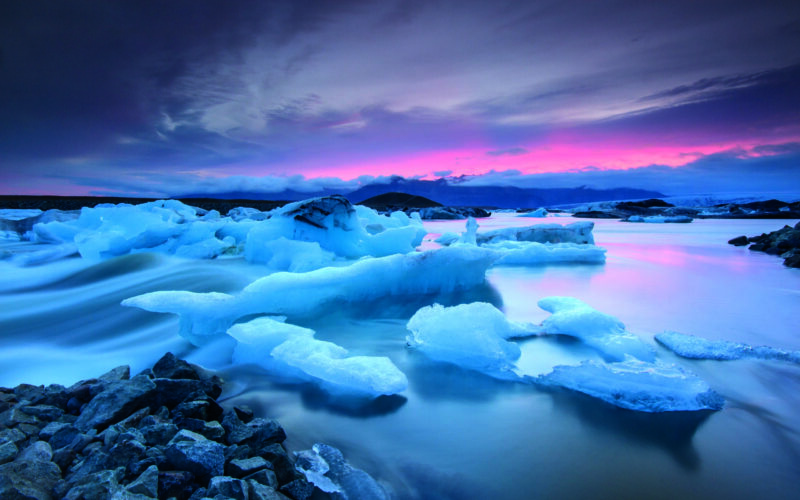
Situated on a peninsula, the surrounding foggy mountains are an ever-present reminder that this is a location completely at the mercy of its dramatic volcanic landscape. It’s unsurprising, then, that Iceland’s distinct character is integral to both its leisure and B2B tourism industries.
A coastal landmark
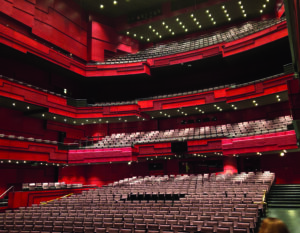
My tour of Reykjavík included the jewel in the city’s MICE crown – the Harpa Concert Hall and Conference Centre. Harpa is the only hall of its type in the country and, like any gem, truly does sparkle. Its striking geometric structure is made from 714 coloured glass panels which are lit by an ever-changing LED light display. According to the management, the honeycomb-esque structure was designed to resemble the volcanic basalt rocks that make up Iceland’s fields and landscape.
Even beyond its design, the DNA of Iceland has been completely incorporated into Harpa, which is fitting considering its primary purpose as the Iceland Symphony Orchestra’s home (resulting in the Eldborg main hall). The venue offers 6,600sqm of conference space accommodating up to 3,500 delegates – the full extent of which is notable at events such as the Arctic Circle Assemblies. On top of this, the centre also provides a selection of smart meeting rooms.
The DNA of Iceland is also included in the building’s infrastructure. As a CO2-neutral building, Harpa uses Iceland’s power grid which is almost entirely made up of renewable hydroelectric and geothermal energy resources. Being at the pinnacle of sustainability has not gone unnoticed, as Harpa is also frequently home to events focused on climate change, Net Zero practices, and energy.
Svanhildur Konradsdottir, the director of Harpa, explained that opening the centre and investing in MICE heavily benefitted Reykjavík’s economy, saying: “Opening Harpa has increased the number of events that are being held here in terms of the mass market and culturally.
“We have so many examples over the 11 years of operation that events have been developed or held here. Some of them are now annual, others are larger one-off events that would not have been held in Reykjavík if it weren’t for Harpa.” She adds that events have covered an array of industries including finance, health, astronomy, equality, human rights, and more.

A home from home
A recent survey demonstrated that 70% of visitors to Reykjavík visited the centre either as a tourist or for an event. The venue’s popularity has impacted the city’s accommodation, prompting the development of more hotels to keep up with demand. The demand is indeed strong – the country has experienced several years where all its hotels have been fully booked for months on end.
The rapid growth of the city’s MICE scene has resulted in many hotels putting down roots only a stone’s throw away from Harpa itself. The Reykjavík EDITION, the city’s first five-star property, has styled itself around its stunning panoramic view of the centre – making itself known to its target clients.
Like Harpa, the hotel has incorporated the DNA of Iceland into its design. The main lobby is styled to the theme of fire and ice, two crucial elements in the Icelandic landscape. It features a cairn at its centre to remind travellers that they have found their ‘home from home’, a collection of photos depicting the daily life of locals, and prides itself in its use of local ingredients and liquors.
Although its current largest market is North America, EDITION’s hope is that Icelanders will be attracted to the venue as well as international visitors and events; especially when its on-site nightclub and spa are fully open to the public.
Nearby hotel real-estate includes the Grand Hotel Reykjavík and Hilton Reykjavík Nordica. Both locations have undergone renovation and are in the middle of expanding their portfolios. Once again, this is a key indicator of the intense demand for high-quality accommodation offerings in the city.
The Grand Hotel team notes that it is striving to place hotels across the island and not just in its capital, to meet current demand of and encourage tourism in the other regions.
Weathering global crises
While it is now obvious that places like Harpa and the hospitality industry have blossomed due to Iceland’s popularity,
the rise of the country’s tourism industry has been rife with ups and downs. There are two crucial points of interest in the industry’s ascension: the 2010 eruption of Eyjafjallajökull (ay-uh-fyat-luh-yoe-kuutl), and the Covid-19 pandemic.
It is notable that Icelanders have a habit of referring to “tourist eruptions”; eruptions which are somewhat unremarkable to the locals but attract flocks of sightseers. An international fascination with the danger of volcanos came as a surprise to the Icelandic tourism industry, which really kicked into gear after Eyjafjallajökull hit the news in 2010 – the eruption of which left many travellers stranded across the world.
Ýmir Arthursson, owner of Magical Iceland DMC and Private Tours, said of the eruption’s impact on tourism: “When it happened, my colleagues in the industry and I thought it was the end of it all – no more tourism. Although we felt like everyone hated us (as the volcano grounded planes globally), people turned their eyes to Iceland and realised that there’s something more here than they thought. From there tourism boomed.”
Mathieu Tari, project manager of MICE at Iceland Travel, shared during a lava tube tour that, once Iceland’s tourism had hit full swing, tours to tubes and caves became incredibly popular – and oversubscribed.
To protect the natural landscape, the decision was made to decrease the number of tourists but, following the Covid-19 pandemic, DMCs were looking to reintegrate these hotspots into MICE itineraries.
The pandemic was another moment where the tourism industry thought that it had seen its downfall, but once again demand only increased. This is largely due to it being one of the earliest locations to reopen to restless international travellers (and arguably one of the safest). By March 2021, Reykjavík’s social life was back in full swing and active cases of Covid-19 were in the low double-digits. Harpa itself only closed for five weeks – a testament to the country’s quick response to the pandemic.
Having weathered two crises of a global scale, and its regular day-to-day life featuring eruptions and earthquakes, Iceland’s ability to pick itself up and dust itself off has its own mantra: Þetta Reddast (thet-ta re-dahst) – roughly meaning “it’ll turn out alright in the end”.
Swapping conferences for caving
I discovered during the lava tunnel experience that there are caves like that all over the country, just waiting for adventurous tourists and incentive groups. Iceland is full of incentive options that move guests from indoor meeting rooms to the untouched wilderness.
The famous ‘Golden Circle’ tour clocks in at a potentially unfeasible 300km (186 miles) for incentive groups but, as we saw, there’s plenty to do within 20 minutes of Reykjavík.
The very same day as the lava tunnel adventure saw my group zooming across the landscape in a super truck, wandering across a black sand beach to see a petrified troll, and exploring the steamy geothermal fields of Krýsuvík after commuting there in ATVs.
The ATV guide informed us that, in his experience, the Krýsuvík pools are hot enough to hard-boil an egg – if you have 19 hours to spare. A different day included more adventuring through Iceland’s volcanic fields but this time from the back of an Icelandic horse.
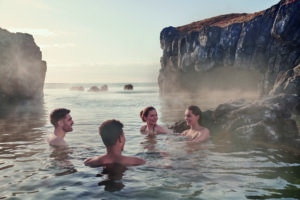
Iceland also has its fair share of gentler incentive offerings, some of which might be more familiar to delegates with a habit of attending indoor events and city breaks. No trip to the island would be complete without a dunk in the lagoons, the most famous of which is probably the Blue Lagoon. There’s a young upstart on the geothermal spa scene however – the equally serene Sky Lagoon opened its waters in 2021.
At the Sky Lagoon, guests experience the incredibly relaxing seven-step ‘Ritual’ involving splashes in cold pools and short stays in the steam room and sauna. Whereas the Blue Lagoon lives up to the baby-blue photos and word-of-mouth legends and also offers a variety of meeting rooms, making it a convenient incentive offering.
In the heart of Reykjavik there’s plenty to do after a day experiencing a luxury gourmet tour of the city. Around every corner there’s a company offering puffin and whale watching tours – conveniently local to events taking place at Harpa. Arthursson explained that the range of incentives are “all on the doorstep of the city… you don’t need to be here for 10 days.”
All our incentive guides spoke with pride and adoration for Iceland and her natural wonders. It was clear that Icelanders weren’t interested in manufacturing an ‘Icelandic experience’ for visitors. There was a true passion behind inviting visitors to see Iceland’s authenticity; by sharing the country’s existing natural splendour and warm hospitality rather than creating it
Arthursson summarised the range of incentives that rely on Iceland’s dynamic nature: “You can be snowmobiling over or inside a glacier; snorkelling between tectonic plates; watching geysers erupt; bathe in the hot springs; or swim in the ocean like the locals do.”
Reiterating that Iceland is a destination where visitors see the country authentically, Tari said that locals and guides “want people to truly experience what Iceland has to offer.”