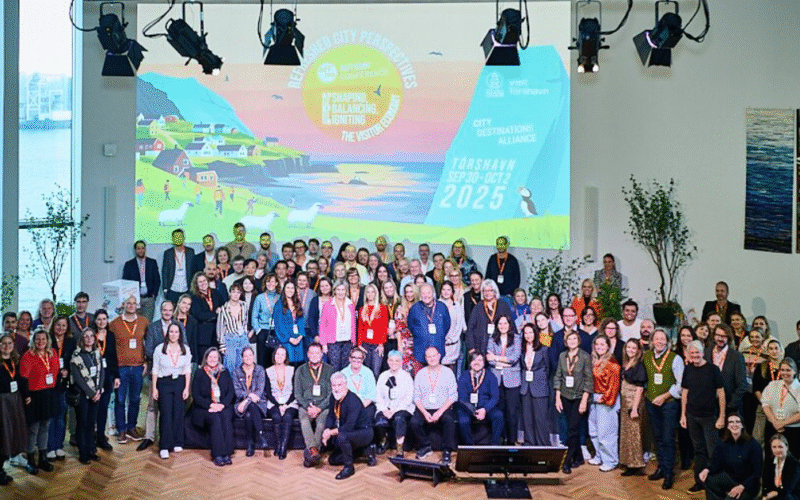
More than 130 leaders from European city destinations gathered in the Faroe Islands for the City Destinations Alliance (CityDNA) Autumn Conference 2025, hosted by Visit Tórshavn from 30 September to 3 October. Under the theme Refreshed City Perspectives, the event invited participants to pause, reconnect and reimagine the visitor economy through collaboration, creativity and purpose. Set against Tórshavn’s dramatic landscapes and warm hospitality, the conference embodied the resilience and openness of the CityDNA community, creating an ideal atmosphere for dialogue, connection and inspiration.
A key milestone of the conference was the launch of a collective process towards the Tórshavn Declaration – a shared commitment to reframe the role of Destination Marketing and Management Organisations (DMOs). Through workshops structured around the Political, Economic, Social and Technological (PEST) dimensions, participants identified urgent priorities for European cities, including stronger advocacy at the EU level, sustainable funding models, inclusivity, AI integration and data ethics.
“The Tórshavn Declaration isn’t a finished text – it’s the start of a movement,” said Barbara Jamison-Woods, president of City Destinations Alliance. “Our members are co-authoring a shared vision for European cities: one that balances growth with care, innovation with integrity, and visitors with residents.” The outcomes of this collaborative process will be refined and unveiled later this autumn, guiding CityDNA members on how to remain relevant in an increasingly volatile, uncertain, complex and ambiguous (VUCA) world.
Speakers throughout the week emphasised the importance of meaning, empathy and authenticity in rebuilding tourism. Jesse Palmer from the House of Beautiful Business reminded delegates that rebuilding genuine community requires empathy and intentional rituals, while Dr Caitlin Morrissey from The DNA of Cities encouraged cities to “decode” their unique identities as a compass for strategic and cultural development. Using examples from Sydney, Manchester, Kyiv and Tórshavn, she illustrated how storytelling, governance and place identity are deeply interconnected in shaping more authentic and resilient cities.
The transformative role of technology and data, when applied responsibly, was also a key focus. Experts such as Bastian Hiller and Friedemann Schütz from Teejit, and Cédric Lopez and Luca Romozzi from Sojern, demonstrated how artificial intelligence and automation can enhance marketing, operations and visitor experience. The overarching message was clear: innovation must remain human-centred, grounded in transparency, creativity and trust. Insights from Dr Bozana Zekan of Modul University Vienna, based on the City Travel Report 2024–2025, revealed that while European city tourism is stabilising and long-haul travel is rebounding, carbon emissions are rising – signalling an urgent need for collective sustainability action.
Beyond the sessions, delegates experienced the Faroese spirit of connection and care through hands-on and cultural activities. A beach clean-up with local NGO Rudda Føroyar and a guided hike to Kirkjubøur offered moments of reflection on environmental stewardship, while the week concluded with a networking dinner featuring a surprise concert by local musician Marius Ziska – an evening that captured the warmth and creativity of Tórshavn’s community.
As CityDNA prepares to finalise and publish the Tórshavn Declaration later this autumn, the Alliance continues to advance its mission of collaboration and shared learning through upcoming events, including the Visitor Experience Expert Meeting in Vilnius (November 2025), the CVB Expert Meeting in Graz (January 2026), the CEO Meeting in Barcelona (February 2026) and the International Conference & General Assembly in Helsinki (April 2026).
“Across every theme, from accessibility to AI, one message stood out,” added Jamison-Woods. “Building the visitor economy of tomorrow requires co-creation – not top-down management, but shared responsibility and purpose.”