CMW speaks with Ryan Simonetti, CEO of US-based venue group Convene, and hears how the ‘one company two brands’ strategy is developing.
You’re the founder of Convene: how did this concept come about?
 Ryan Simonetti: My dad was an entrepreneur and owned a bread delivery company.
I’ve been in and around the food and hospitality business since I was a youngster, so I’m not too surprised that when I decided to start a company, there was a tie back to hospitality. After university I stumbled into real estate and worked at Lehman Brothers and later for a real estate investment company.
I did a lot of office and hotel investing. If you go back to 2005-2008 in the United States, it was the birth of lifestyle as a movement. We saw Whole Foods, Trader Joe’s, Equinox Soul Cycle, Ian Schrager with the whole boutique, hotel room, and W Hotels, the brand. But nobody had really thought about bringing the lifestyle experience into the workplace or into an office building. And so the thesis for Convene was, what if you ran an office building like a hotel, and you brought in the amenities, the meeting and event space, the food service, the tenant lounge, and cafe, could you create a better experience in the building? Could you also become a place where companies in the community could host their events and meetings instead of going to a hotel or doing it internally, and at the same time, do it in the way that a hotel brand can create value for the owner or developer of a hotel?
We opened our first location in 2009 in the middle of the financial crisis. Building owners felt that having access to that meeting space experience in their own building would be really helpful for new tenants who would not need to build a large training room, but could just use Convene in the building.
The world and our business have both evolved, but the core thesis has remained consistent. What differentiates us, similar to the etc.venues, product and platform, is really intentional design, great food, technology that works, but most importantly, the human element. There really is a difference between service and hospitality. Hospitality to me is emotional or human to human delivery of a service experience. We do that really well and have built a brand on that. We had a great run up until Covid. We were up to 34 locations, multiple cities in the US, and about to open in London. We’ve since scaled down the business, to some extent, and positioned ourselves to the point where, coming out of it with new capital partners, we were in a position to do things from an M&A perspective.
Did you manage to retain most of your staff?
RS: In the US, unfortunately, they had nowhere near the level of support or government support that was available in the UK. We went from 1,000 people to 120 and stayed there for two years. And now collectively, between us and etc.venues, we’re back up to over 900.
When you came up with an idea for Convene, were you aware of etc.venues?
RS: No. At the time in the US there was nothing like it. About a year into the business. I was at an IACC conference, and etc.venues happened to be there. Alistair Stewart and I had an incredible conversation. He was telling me what they were building in the UK and I was telling him what we were building in the States. We always said that at some point, it would probably make a tonne of sense to bring you these two great organisations together. We danced a few times where they say the third time’s a charm. And, thankfully, this was the right moment in time to bring the two businesses and brands together.
Our plan is to have one company, two brands. There are 13 venues part of the etc.venues brand – three in the US. We’ve got 22 Convene venues and other interesting things in the pipeline. We feel that the future of our industry looks and feels more like the hotel industry where you can operate multiple brands that speak to different segments of the market, and to different size meetings and different budgets.
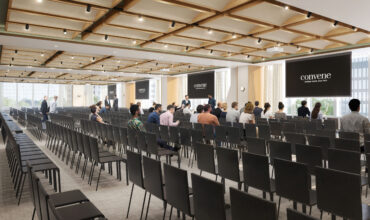
What I like about the portfolio we have in particular in London is this mix of great venues geared towards smaller sized training and meetings, but it also speaks to the budgets of our customers in particular around their internal facing meetings and events. And then, with the addition of 22 Bishopsgate, and County Hall and 155 Houndsditch and St Paul’s, we have a growing network in London of what is larger scale premium conferencing and event venues that deliver a different type of experience.
You mentioned Europe. Do you have plans to expand there?
RS: We have the same scale in New York as we do in London – our two biggest markets, but we’re also in Boston, Chicago, Philadelphia, Washington DC, and opening in San Francisco. We’re in the process of expanding into Canada. And we will have, in the next 24 months, several locations in Toronto. There is definitely an opportunity to add more in London, and in Manchester and Birmingham. Then Europe would start to be the focus. Our head of real estate growth has been spending time to better understand the European markets. Our thing is always for customers to lead the way. We have a list of six to eight cities and markets in Europe where we think we can be successful.
When looking for a new location, does it have to be a particular type of building or space? What are the key characteristics you look for in a venue?
RS: Each brand has a little bit of a different typology. If you look at the bigger conference and event, you obviously need more square footage. You need large column free space and ceiling heights to run large capacity events. So that’s definitely a challenge in any market. Ideally, you’d like to be able to control the welcome experience and be able to move people in seamlessly. We always say hello, coffee and goodbye is really important. How do you feel when you show up? What’s the last thing you remember? And how do you feel when you walk out the door? Controlling that welcome experience is really important. And then what’s nice about the more training oriented, etc.venues portfolio, your smaller square footage can go into smaller buildings and to some extent, you don’t need to be in a classy office tower with 40,000 square foot floor plates to open one of those. We’ve got more flexibility there.
Diversification of the customer base is important, so we like to design spaces for progressive organisations, regardless of shape and size.
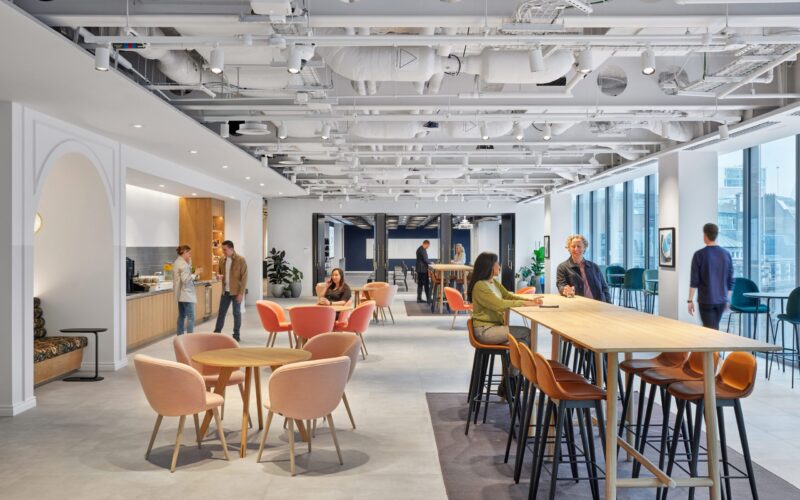
For the most part, we have two core products, we have our meeting event conferencing and training product, which really comes in two shapes and sizes: we’ve got the smaller etc.venue venue, kind of training meeting, and then we’ve got these bigger flagship venues that can do events of, 1,000 people. And then we’ve got what we call our workplace product. As part of that we have both private offices where companies of 10 to 100 people outsource their office to us, and get access to all of the amenities and shared infrastructure that we build.
We also have a small but growing part of our business that’s membership based.
How much emphasis do you place on sustainability?
RS: It definitely feels like the European customer base is a little bit ahead of what we’re seeing in the US, but it’s a commitment not just by us, but our clients, and also our landlord partners, to continue to find ways to be more sustainable. And that has broad implications that change how we design space, getting rid of single use plastic, managing food waste. We have a plan to become carbon neutral and we share that with our customers.
In the in the UK, I’ve been to 20 or 30 meetings in the last six months with the head of global meetings, events or procurement, and I would say in 90% of the meetings, the first question was ESG related. It’s the first question, so it’s definitely front and centre.
In 2019 you delivered over 6,000 events. Last year, you did just under 3,000. Are the numbers increasing? How are forward bookings looking?
RS: What we’ve seen in revenues this year means we’ll be pretty much back to 2019, although the way we’re getting there is different. What we’ve seen is fewer events, but bigger, more experiential events with larger budgets.
In many cities in the US that we’re in, I’d say most people are in the office, maybe two to three days a week. It feels like in the UK and in London in particular there seems to be a quicker return to office and also just face to face.