
The German Convention Bureau (GCB) shares its approach to creating meaningful event content through the ‘Response Room’:
Open Innovation is one of today’s businesses keys to success. But what exactly is open innovation – and what isn’t? And, more importantly, why should all business event stakeholders be concerned with innovation?
Here you will learn more about the open innovation platform ‘Response Room’ and its recent ICCA innovation challenge as a best practice case to demonstrate the usability and efficiency of the concept behind it. This challenge has turned out to be a valuable example for how to achieve a common goal based on the ideas of a global community.
What is open innovation?
Dr Henry Chesbrough, who coined the term ‘open innovation’ has a clear opinion on its value: “At its highest level, open innovation is a recognition that no man is an island, and we can’t do it all ourselves”. The basic framework of open innovation is based on a permeable, mutual exchange of external and internal ideas. Chesbrough appeals to organisations to integrate external ideas into their own innovation activities along with internal ones, and equally share unused or underused internal ideas with others outside the own company for their innovation activities. Thus, open innovation has an outside-in part and in inside-out part.
Open innovation for business events: the Response Room
Many innovations have already transformed society and industries significantly as a whole and will certainly continue to do so in the future. Innovations can vary widely in size and scope, but they all have in common that they are novel to their specific field. Open innovation holds great potential for solving complex issues and creating new technologies, ideas, or products. Especially in the event industry, new solutions are needed in order to best meet the challenges of the coming years and the resulting changes in lifestyles and working practices. Therefore, the German Convention Bureau initiated the open innovation platform Response Room in 2021, together with the IMEX Group and PCMA as co-initiators, in order to find solutions for these changing demands.
Responose Room is an easy to use, intuitive platform that is open to everyone who wants to engage with the business events community: from meeting planners and event tech specialists to hospitality experts or destination marketing pros; from students and young professionals to senior managers and executives; from start-ups and self-employed to corporates and associations. In the Response Room users can address and participate in challenges, find inspiration in the innovation blog, and stay tuned on upcoming events. Registration is easy and free!
Open innovation as an instrument for meeting designs
Open innovation functions on various levels, but always with a concrete goal: To drive change and to be ahead of the time. To implement open innovation concretely, it is advised to seek knowledge, ideas, and collaboration outside of corporate boundaries. Thoughts, ideas and participation of a large, diverse community are the basis for innovation. Therefore, it is important to focus on user needs early on and to use the swarm intelligence of the community as a central success factor.
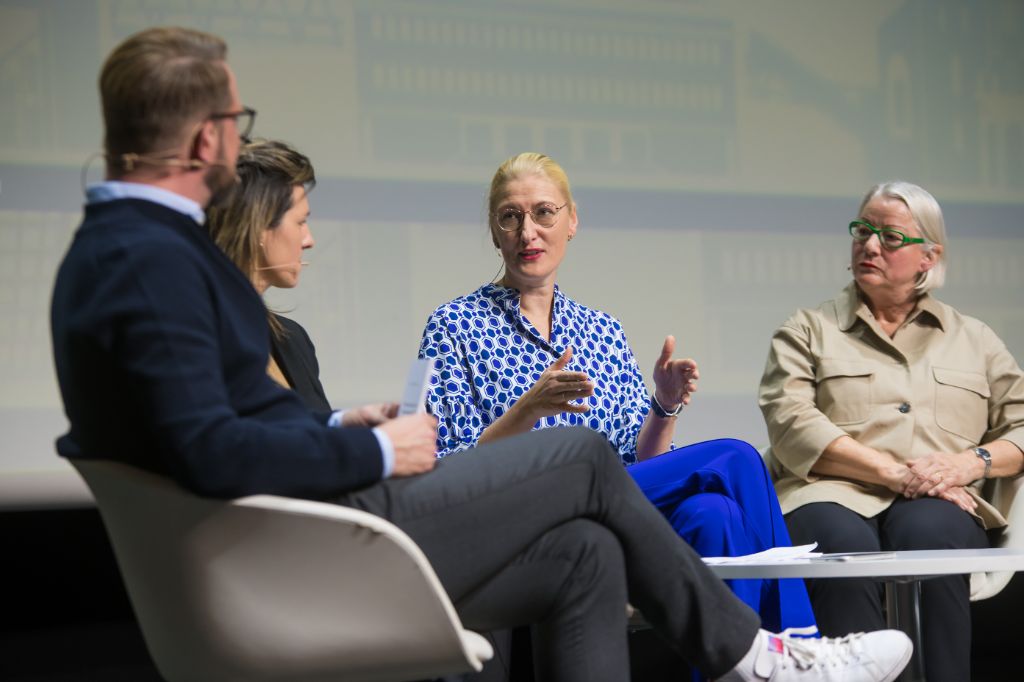
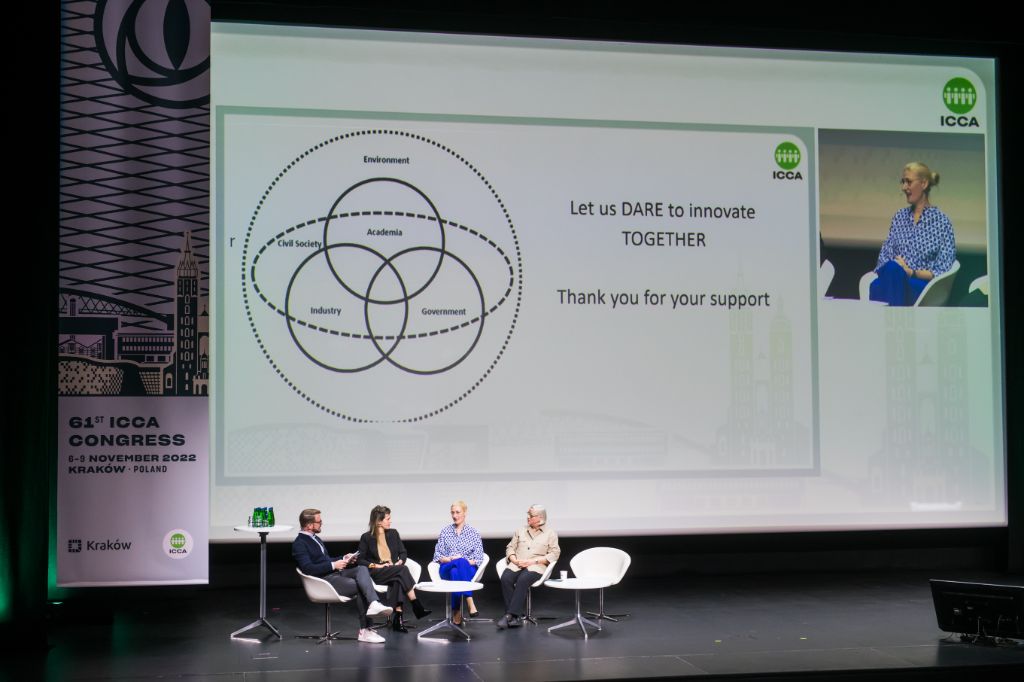
One best practice example of open innovation as an instrument for meeting design is the recent Response Room innovation challenge for the ICCA Congress in Krakow. This challenge was designed to identify innovative ideas and projects leading up to the congress in early November 2022. Users from all around the world were submitting ideas, commenting on them, and finally voting for the best projects on innovation that were presented and discussed live on stage at the ICCA Congress. The challenge started weeks before the congress and let the community become active. The Response Room functioned as an interactive, digital, and collaborative instrument for meeting designs. The platform has provided the space for collaborative exchange, driven the emergence of ideas, and ultimately translated and implemented them in a practical way.
In the end, the community submitted 30 innovation projects. Almost 200 people participated actively and contributed more than 90 comments and nearly 300 votes.
Open innovation projects at the ICCA Congress in Krakow
The voting resulted in three winning projects: Conferli from the Netherlands (87 votes), ecomice from Germany (35 votes), and ‘Magnid meets Metavers’ from Germany (31 votes). The winners of the innovation challenge presented their projects on stage in Krakow during a congress session facilitated by Matthias Schultze, the GCB’s managing director.
Conferli works on a project to identify the SDG’s for 280 European destinations. This information will be incorporated into the country and cities profiles in the platform. A filter will be created in the matching tool which will offer associations the option to select destinations based on their SDG’s. With this new feature it will make the destination selection process of associations easier because they can get matched on cities that focus on the same SDG’s as the association does. With this new possibility, goals on legacy/impact will be more easily incorporated into the conference planning process from the immediate start.
Ecomice focuses oncross-sector supply chains and SDG-related legacy projects in the meetings industry. It is a new initiative to research, identify and integrate sustainable strategies and innovative projects in destination and congress marketing. With their project they focus on conserving ‘Our Water Legacy’ together, between meetings and local stakeholders in the destination. Water innovation comes in many different ways and the cluster offers a high-quality approach to destination marketing, a first-of-its-kind pro-active strategy to collaborate – as an industry – on a widely ignored challenge for most destinations: water. With their initiative ‘Frau Blau’ they are working to positively counter the alarming state of water scarcity at a global level.
Magnid/Proske: The goal is to create an easy entry into the metaverse for everyone. The ‘Magnid meets Metaverse’ project provides this with an additional interface for strategically attractive and, above all, sustainable meetings. This allows participants on a B2B level to engage, collaborate, network and experience 360° content from all angles, as the metaverse offers a distraction-free environment with full focus on the individual meeting. Magnid as an AI-supported, cloud-based platform for virtual and hybrid events with scalable 3D worlds can thus take participant activation to a new level of involvement.
As all of these examples show: Innovation requires more creativity and more willingness to take risks than the implementation of traditional projects. To successfully realise innovation projects, a different mindset is needed. This requires a willingness and readiness to invest also beyond one’s own company, share challenges and ideas with the community, create freedom, learn from mistakes, and finally establish an innovation funnel that narrows down ideas into concrete projects.
What is next?
Are you looking for innovative ideas to advance your own projects? Maybe you want to start an innovation challenge, too? Send us the topics you are currently working on, and we will engage the community to collaborate on your ideas. Together, we will drive innovation for business events.
For more ideas and inspiration, check out the Response Room!
Contact:
Dr Martina Neunecker
Director Communications & Strategy
GCB German Convention Bureau